
The Future of Work Includes Caregiving
Architects lead the way in tackling the “working while caregiving” challenge
The sandwich generation: if you’re in it, you know it, with caregiving responsibilities for both children and elders, most likely shouldering those responsibilities while managing a full load at work. But even if it’s “only” the kids, or your elderly mom, or another family member or friend, the juggling act is taxing.
For working people also engaged in caregiving —70% of U.S. employees according to the 2025 AARP/National Alliance for Caregiving report — the whole endeavor often feels like a recipe for failure, with compromises at home and at work that leave both employees and the companies they work for wanting. Job performance, morale and mental health, career growth, team strength — all suffer.
The New England Employee Benefits Council now considers caregiving “a central force shaping workforce dynamics, employee well-being, and organizational resilience.” In other words, the fact that nearly three quarters of the American workforce grapples with how to manage paid work and unpaid caregiving is as much a corporate problem as it is an individual challenge.
While architecture firms range in size from a handful of employees to hundreds, with systems and benefits that vary accordingly, what they share are long hours and intense project cycles. Too often, the lack of structured support for employee-caregivers — or conversely, all too structured policies — leads to burnout, career stagnation, or attrition.
Fortunately, architects are born to solve problems. After each having different experiences surrounding maternity leaves, Jones architects Silvia Colpani, Alya Staber, and Elona Habipi felt sure there was a better way, especially when caregiving involves taking a leave of absence. In 2024, the three developed a proposal around an essential question:
How can architecture firms boost retention and productivity while supporting employees who are also caregivers?
The team applied for and received the AIA Young Architects Forum $10,000 Future Forward grant, sponsored by the Large Firm Round Table – the program’s first award for a research project, with Jones Architecture and the Boston Society of Architects (BSA) providing support and matching funds.
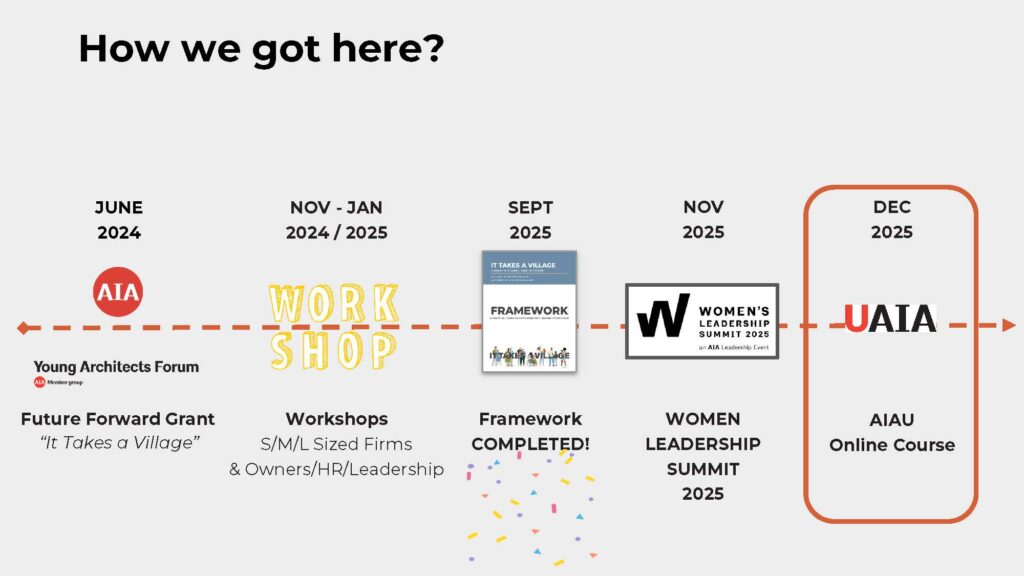
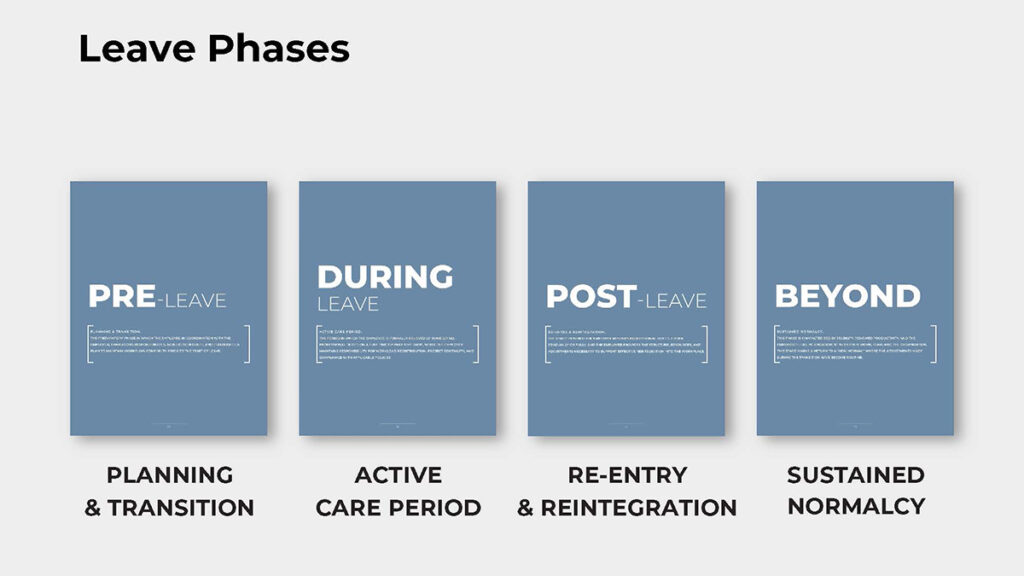
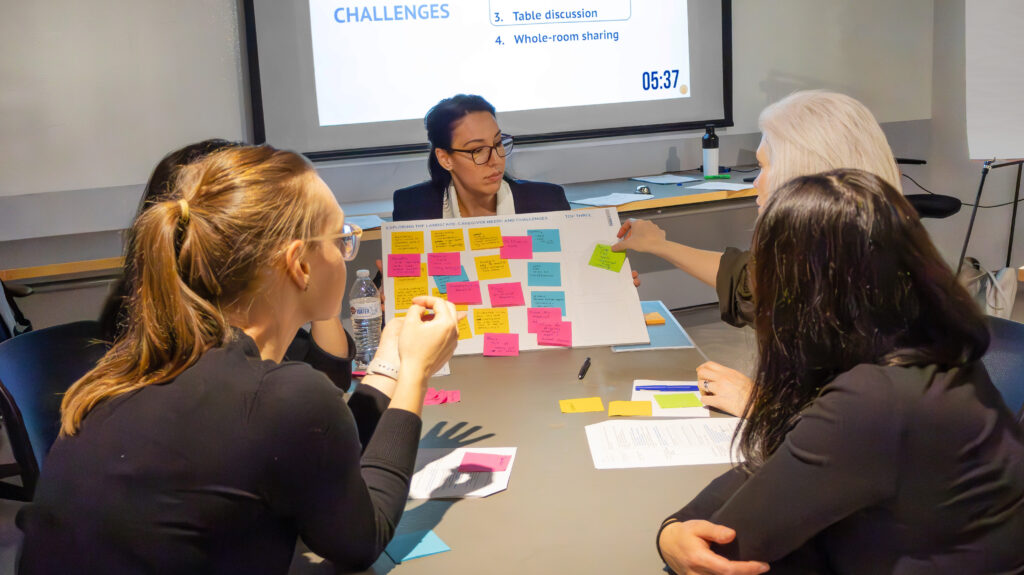
Next, they held focus groups featuring different architecture firm sizes and cohorts that included employees, owners, managers and HR professionals, then spent months analyzing results and developing a response. The yearlong study yielded the It Takes a Village Framework , subsequently recognized by the BSA in 2025 for an Innovation in Practice Award. This practical, modular guide is scalable for any size firm interested in helping employees manage caregiving transitions and responsibilities with consistency and care. The Framework encourages cultural change by promoting shared responsibility, transparent communication and structured processes.
These simple principles go a long way toward alleviating three of the biggest challenges for working caregivers: ambiguity, stigma and career disruption. The Framework also addresses time “beyond” reentry, i.e. for anyone with caregiving responsibilities, whether they take a leave of absence or not.
Shared accountability; flexibility and transparency
A key component of the framework is the idea of shared accountability.
“Employees need to speak up, and ask about possibilities,” notes Staber, while employers need to know that “communication, clarity, and transparency are the simplest, most effective, and least costly solutions for building trust.”
The Framework highlights defined responsibilities for employees and employers as well as shared tasks. Flexibility in work hours, phased re-entry, and open, honest communication, including about career pathways, are also key features of The Framework, which includes sample questions and checklists.
While most firms offer some flexibility in work hours, about 20 percent do not (AIA Compensation and Benefits Report, 2023).
“Flexibility isn’t a perk,” the authors emphasize. “It’s a strategic necessity for any organization that values its people and its future. It allows firms to retain talent, foster diverse leadership and future-proof their practices.”
Growing need
Time devoted to family caregiving nationwide has more than doubled since 2020, ranging from 20-30 hours per week on average according to a 2025 study by Guardian Life, an insurance benefits company.
That’s a huge jump, and yet the need for caregiver support in the workplace is only growing. In 2024, The Society of Human Resource Managers (SHRM) conducted a survey of more than 3,000 working caregivers. In the next five years, more than half (53%) anticipate new or additional responsibilities (18% for elders, 21% for children, and 14% for other adults). A further 13% of workers surveyed who are not currently caregivers anticipate taking on elder caregiving responsibilities in the next five years.
Access to workplace support benefits has improved over the last decade but it is uneven; about half of working caregivers do not disclose their responsibilities to their supervisor (Caregiving in the US 2025).
This reluctance speaks to one of the key obstacles to better support that the research team uncovered during the focus groups: mindset. Office culture has negative connotations with people who have caregiving responsibilities, with leave-taking often viewed as a vacation.
While the shift toward normalizing support needs, such as picking up kids, or Zooming in to a parent’s doctor appointment is happening both in the AEC sector and outside it, there is a long way to go before the Jones’ goal for the
Framework is realized: obsolescence.
“We’d like the policies to be so normalized, simple, and clear that this guide is no longer needed,” said Colpani.
Not just women
Success hinges in part on encouraging men to assert themselves, so they can get the support they need, and to help break down the negative judgment that persists around working caregivers. While understanding is growing, 20% of working caregivers report poor treatment at work because of their caregiving responsibilities, and 22% say there is a stigma around being a caregiver at their organization (SHRM 2025).
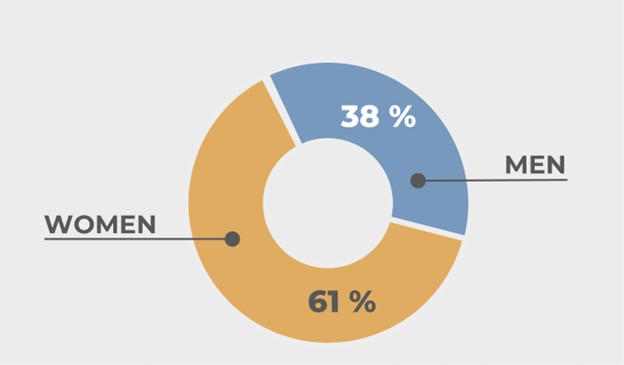
Worryingly, the Guardian study notes a “gender flip” in full-time working caregivers: 57% are now men (up from 44% in 2023), while women dropped from 56% to 43%. This is primarily a function of women simply dropping out of the workforce due to caregiving responsibilities.
Company leaders take note
Large firm leaders should not assume they’ve got this issue covered. According to the SHRM study, while most employees (80%) say caregiving affects productivity — only 24% of employers say it does. Working caregivers miss 1.2 workdays a month on average because their obligations are not adequately supported. In 2024 nearly 30% reduced their working hours, more than 20% scaled back their work loads, while 14% changed jobs for more flexible opportunities.
It is certainly true that bigger firms (50+ employees), typically have robust HR systems and resources, which results in better-defined policies and procedures than exist in smaller firms. For example, navigating Paid Family and Medical Leave paperwork can be a complex, frustrating undertaking without the help of an HR team that knows the ins and outs of the policy. That said, the team found that the firms with established polices were often not flexible, more focused on legal implications than the humans they are intended to serve; their impersonal nature can leave employees feeling devalued. The opposite is also true: small firms might be too flexible and tailor policies on a case-by-case basis, which can lead to resentment, if not legal problems.
Obstacles
The workshops helped identify the many hurdles people face when balancing caregiving and work responsibilities. Examples of comments we heard: “Daycare and aging parent home care are expensive!” “No discussion about expectations.” “No boundaries from co-workers during and after leave.” “Need staffing redundancy and overlap – not minimum.” “Not being able to adjust work schedule for family emergencies or school closures.”
Four themes emerged, which informed the Framework’s key principles: flexibility, mindset, communication, transparency. Not rocket science, but surprisingly absent from many well-intentioned firms, whether they have established policies and benefits or not. The Framework picks up where policy leaves off – providing a practical, research-backed resource for employees, managers and owners.
“Working while caregiving” is here to stay. When companies get it right, they get ahead. By adopting this approach as a complement to policies and benefits, firms make themselves more competitive; they can reduce burnout, support equitable career pathways, and position the architecture profession as a leader in progressive workplace practices.
“The challenges working caregivers face are not solely tied to their caregiving roles but are compounded by inadequate sources of additional supports to meet their needs. The key issue for employers to address is not caregiving itself, but the lack of sufficient resources and structures in place to assist caregivers.” – Society of Human Resource Managers; The Caregiving Imperative.
For a deeper dive into this issue, see resource links below.
Society of Human Resources 2025 Report Summaries
Fast Company on Caregiving
SHRM: Care and Careers: Navigating Caregiving and Work Responsibilities
Harvard Business Review: The Caring Company
AARP and National Alliance for Caregiving: Caregiving in the US 2025