
Designing on the Cyber Spectrum
From Top Security to High Engagement
With cybersecurity job growth projected to top 30% over the next decade, demand for educational environments that prepare the next generation of cyber professionals is accelerating. If you are one of the many high schools, universities, and private-sector partners across the country that are launching programs that blend technology, security, and hands-on learning, you need to know where you land on the cyber spectrum to achieve an effective and enduring learning environment.
Cybersecurity teaching and learning spaces must balance what is seen and unseen, with infrastructure and power capacity working quietly beneath the surface while visible elements of transparency, engagement, and collaboration draw people in.
Over recent years, Jones Architecture has helped design and deliver a range of facilities that reflect this duality. Together, they reveal a design spectrum that extends from flexibility and adaptability on one side to specialization and security on the other. Both directions are essential, often intersecting in ways that shape how students and professionals learn, experiment, and engage with technology.
Why Cyber Education Matters Now
Cybersecurity is no longer a niche field; it’s a national priority. As industries digitize and cyber threats evolve, educational institutions are under pressure to keep up, building facilities to accommodate rapidly expanding programs. Curriculum ranges across the educational continuum — from high school STEM initiatives introducing cybersecurity basics to advanced research hubs training tomorrow’s analysts and engineers.
At the same time, technology itself is changing faster than the spaces built to house it. Network infrastructure that felt cutting-edge five years ago can now be obsolete. Power demand, data capacity, and connectivity expectations grow with each semester. And with funding for these programs often tied to grant cycles, schools are challenged to design and construct complex, technology-intensive environments on compressed schedules.
For architects, that means designing spaces that can flex and evolve as new technologies, partnerships, and pedagogies emerge, while managing demanding delivery parameters.
Two Approaches Emerging
Through multiple projects in academic and applied settings, we have observed two main trajectories in the design of cyber environments.
Approach One: Infrastructure and Flexibility.
Focus: Building a robust platform
These projects prioritize adaptable systems that can evolve as technology changes. Spaces are designed with raised-access floors, generous ceiling and wall capacity for cabling, and oversized data and power rooms that anticipate future growth. The goal is to accommodate new equipment, reconfigurable workstations, or evolving instructional models without major disruption.
Examples like Norwich’s Cyber Fusion Center and Lake Howell High School’s cybersecurity lab reflect this approach. In these projects, adaptability itself is a form of resilience. The architecture supports a constant state of iteration: layouts shift, technology upgrades, and new uses emerge as the programs expand.
Approach Two: Specialization and Security.
Focus: Security and defined, tailored use.
These environments emphasize specificity — high-performance rooms like Security Operations Centers (SOCs), simulation labs, and “war rooms” that mimic real-world defense and intelligence facilities. These spaces integrate advanced infrastructure with defined layers of physical and information security. In many cases, the security itself becomes part of the story: visible enough to showcase the program’s capabilities but controlled enough to maintain compliance and integrity.
At UMass Lowell, for example, the Cyber Security Operations Center was designed as both a learning environment and a working demonstration of operational cybersecurity — a place where visibility and confidentiality coexist.
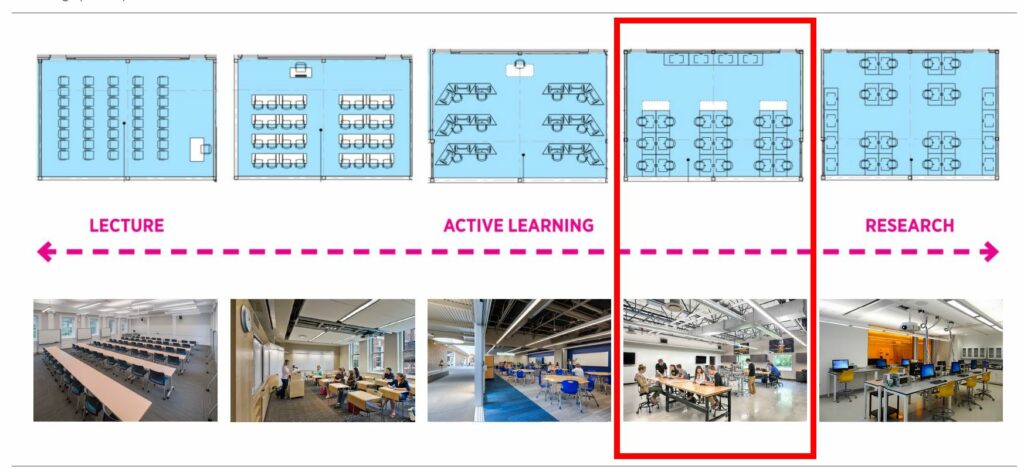
Designing Across the Spectrum
Most institutions don’t live fully on one end of the spectrum or the other. Instead, they operate somewhere in between — requiring environments that can pivot between open learning and secure operation. The key is identifying where on that continuum a given program needs to be.
Designing for this balance requires early dialogue and interdisciplinary coordination. Architects, technology consultants, and engineers must work together from the start to understand how secure systems, power infrastructure, and human interaction intersect.
Jones’s work across these projects has surfaced a recurring set of questions that shape the design process:
- What level of physical and information security is required?
- How specialized should each space be, and where is flexibility more valuable?
- How visible should technology be — as a teaching tool, a showpiece, or an invisible enabler?
- Should the program emulate industry operations or function as an entrepreneurial incubator for research and innovation?
Each answer determines how systems are layered, where transparency is appropriate, and how students and professionals will experience the environment.
Designing for an Uncertain Future
The most enduring cyber facilities are those that prepare for change rather than attempt to predict it. Jones’s approach emphasizes infrastructure as a long-term investment — a foundation for technology yet to come.
Raised access floors, accessible ceilings, and modular layouts make it possible to replace or expand systems without disruption. Electrical and data rooms are designed with capacity beyond current need. Cabling pathways, air distribution systems, and equipment zones are intentionally oversized to accommodate future configurations.
Equally important is the human and organizational infrastructure that supports these spaces. Early engagement with technology consultants ensures compatibility between architectural systems and digital platforms. Regular coordination among design teams, contractors, and end users allows the project to evolve as funding, equipment, or curricula change during design and construction.
In every case, the goal is to design for adaptability —for today’s network and tomorrow’s unknowns.
The Human Element
While much of the discussion around cybersecurity education focuses on hardware, software, and infrastructure, the human dimension is just as critical. These environments are places of learning, collaboration, and discovery.
Spaces like Norwich University’s Cyber Fusion Center demonstrate how architecture can bridge the gap between digital abstraction and physical engagement. Within the center, simulation labs replicate real-world security operations and give students hands-on experience responding to threats in real time. Transparent glazing, open layouts, and shared breakout areas invite observation and collaboration, turning the work itself into a teaching tool.
At Lake Howell High School, Jones designed a lab that introduces cybersecurity concepts to younger students, connecting them with career pathways that lead toward higher education and industry opportunities. The environment had to be both secure and accessible — advanced enough to inspire curiosity, yet approachable for beginners.
The firm’s design for Northeastern University’s Drone Lab pushed this principle further. While not strictly a cybersecurity space, it embodies the same design logic — flexible infrastructure supporting an unpredictable future, and a focus on hands-on learning where technology, entrepreneurship, and design intersect.
Visibility as a Teaching Tool
Visibility plays a nuanced role across the cyber design spectrum. Some programs, particularly those in higher education, use visibility to spark curiosity and demonstrate capability. Glass-walled SOCs or simulation labs provide a controlled glimpse into the activity inside — a literal window into the program’s sophistication.
Others take the opposite approach, embedding security deeply into the infrastructure and using architectural restraint to convey control and confidentiality. Both strategies serve educational goals: one inspires engagement, the other instills discipline and respect for the systems that protect information.
Jones approaches each project by asking how visibility can support learning — whether through transparency, proximity, or storytelling.
Looking Ahead
Cybersecurity is a field defined by constant evolution. The same should be true of the spaces that support it. As educational programs expand and diversify, design must anticipate continuous change in technology, pedagogy, and industry collaboration. Jones’ growing portfolio of cybersecurity environments shows that architecture has a unique role to play in this mission — not just housing technology, but translating it into learning, experience and opportunity.
For institutions seeking to enter or expand within this field, success depends on a design strategy that expects change, while bridging security and accessibility, infrastructure and innovation, visibility and control. Every institution must locate itself on the cyber design spectrum: between secure and shared, visible and invisible. The best designs do more than respond to that balance — they enable it, empowering educators, students, and industry partners to thrive in a rapidly changing digital world.